

Teaching Personal Skills In the Classroom
Teaching Personal Skills In the Classroom
There was an Instagram Reel trend going around recently for teachers. So obviously, it was always in my feed. It was a picture of a teacher on summer break with the caption “Yes, I get summers off but I also get…” and the rest of the carousel was the impactful things they do in the classroom with their students. Like building relationships, cheering on their students, watching students' curiosity blossom and so much more.
When I think about what I would write on that type of post I want to say “I saw students become well-rounded, passionate people in whatever field or life path they chose.” I care so much more about the personal skills they learn in my classroom than the content. Hands down.
Some Career Tech programs have leadership skills or soft skills in their curriculum. But, some of us either don’t have it in the curriculum or tend to skip over those standards in order to get to the meat of the curriculum.
I like to think about personal skills as the bones. If you don’t have the bones the meat is just mush with no structure.
Teaching personal skills are important regardless of the content area.
Some of these skills are taught through your classroom expectations and routines. Some you might need to stretch a little bit for students to understand and then practice.
Could you imagine if all of your students understood and consistently demonstrated things like:
✔️Accountability
✔️Curiosity
✔️Initiative
✔️Active Listening
✔️Generosity
✔️Patience
✔️Organization and so many more.
That would be the DREAM right?! But, I will say, the kids won’t grasp it unless we are intentional about teaching, encouraging, noticing and practicing these skills with them.
I know for me I learn a lot of these skills through my involvement in extracurricular activities like 4-H, overnight camp, sports teams and clubs.
I don’t remember one class I took in middle or high school that explicitly taught me how to be a WELL-ROUNDED PERSON.
But, be mindful and remember that not every student will be active in an extra-curricular activity. For a wide variety of reasons you may never know. This is why teaching in the classroom is critical so all students get the benefit of learning these skills.
This is something that I want to change in my classroom. I want to make the space for students to practice these characteristics so they can continue to hone them as they continue through formal education and into their careers. Because someday they will be my doctor, child’s teacher, military, doctor, administrator, business owner, and so much more. And I want them to be equipped to be the best “whatever” they want to be.
So how do you teach these skills and keep them on the forefront of your classroom when you have 587 other things to achieve in the year? I have a few suggestions that I have used in a variety of classrooms that you can try out.
I think it is also something that you can invent on your own. Puzzle piece together some ideas and tweak and refine until it fits your classroom vibe. Like always, remember these are just suggestions to get your brain going. You are the expert in your classroom, with your students and your community and know what works best!
4 Ideas to integrate Personal Skill Development in your Classroom
Classroom Jobs
Classroom Jobs have been integral in both my middle and high school classrooms. And we all know elementary students love a good job! Classroom Jobs are good for all ages. I have done some jobs that are as simple as a “stamp team” who stamp warm-ups each day to application based jobs where students were in charge of classroom animals for an entire year called “animal mentors.”
Most of the time when creating classroom jobs I think of a task that I could off-load to a student (with proper training). This makes having classroom jobs a win-win. Students are practicing personal skills and you have less work to do!
So when you want to implement these classroom jobs ask yourself these question:
-What is a task that I do that I could delegate to a student?
-How will I select classroom job holders?
-How will I evaluate their performance in personal skill development?
Weekly Focal Characteristics
Something very simple you could try is having one personal skill as a focal skill for that week. Introduce the characteristic in class on Monday with a definition and class discussion on “how can we demonstrate this skill in class this week” and then be on the lookout for that student throughout the week.
I have seen ideas on Instagram of the selected student from the prior week chooses the next week's winner. You could also have a voting box/google form for students to provide evidence of their nomination.
I think this year I might be using my wheel of names to randomly pick a student at the beginning of the week to watch for the demonstration of that skill. Then at the end of the week if they achieved progress, I would reward them with a positive note home and something from my prize bin!
To get started using this technique ask yourself these questions:
-What characteristics are important for my students to learn and develop?
-How will I teach students about this skill?
-How will students demonstrate and be rewarded for their progress?
Quote/Leaders of the Week
Do you use warm-ups during the week? Yea, me too! A simple switch could be taking one day during the week to do a quote or leader of the week that demonstrates a personal skill.
Your students will still get the content warm-ups throughout the rest of the week. Just add these quotes/leaders to one day for a quick discussion session with your students. You can also use the same techniques of rewarding these skills from the previous idea!
When implementing a quote/leaders of the week as yourself these questions:
-Do you want to use quotes, leaders or a combination of both?
-When will you present these quotes/leaders to your class?
How will students demonstrate and be rewarded for emulating that skill from the quote/leader?
Personal Development Ponderings
I created this activity with my leadership class that actually had standards related to this activity. Students were assigned a week to present a Personal Development Pondering (PDP as we liked to call them) on Friday. Students would live their life looking for demonstrations of Personal Skills throughout the week. This could be something they saw in class, on a TV show, in a sports practice, at a club meeting, something they saw on a TikTok, something they read in a book/article. Truly the sky was the limit.
Then on Friday, they would stand in front of the class and share about their observation and how that connected to something we learned in our class. I vividly remember a student brushing her teeth during a PDP talking about consistency as a leader. So creative and very memorable.
This was a great way to take the training wheels off and let them experience personal skills and share about them in their own way.
This idea was used exclusively in a higher level leadership class but could be modified to fit your students!
If you decide to implement PDPs, ask yourself these questions to get started:
-How will students be assigned this assignment?
-How will students present or share their PDPs?
-How will you grade them?
If you can’t tell, I am very passionate about preparing students for their future. Not just because my content is important but because our job as educators is to prepare them for life. I take that job seriously.
Personal skills can be cultivated in so many ways but don’t fall into the trap that just because you have high achieving students they know and are proficient in these skills. Just like any skill like driving a car, creating a TikTok, changing your smoke alarm batteries, mowing the law, doing a pull-up, it requires practice. Challenge yourself to give your students a safe place to practice these skills!
Classroom Mgmt Series: Why Routines Aren’t Just for Elementary School (And How They Reclaim Your Class) Part 1
Why Routines Aren’t Just for Elementary School (And How They Reclaim Your Class) Part 1
You need a plan/routine for vital parts of your classroom. Not everything. Your class will move organically in certain situations. The tricker parts are the transitions.
This school year I didn’t start off strong, TBH. I had some things under control like my cute classroom rug, color coded table numbers and table bags of supplies. What I didn’t figure out until after winter break was that my kids needed consistency and routine. Heck, so did I!
I would find myself frustrated that they didn’t follow my exit directions on the board, they didn’t come into class and immediately start their warm-up, that they didn’t know when it was appropriate to ask to go to the bathroom.
But, it wasn’t on them to read my mind. I needed to give them deliberate specific instructions on what to do, how to do it and when to do it.
I truly didn’t hit my stride until after spring break when I really felt in control of my classroom environment.
And now as I look toward the next school year I feel like I need to write this all down so I don’t forget. So I am happy to have you come along for the ride for this series about the non-negotiable classroom routines in my classroom that just might help yours run smoother.
As always, I preface this as these are things that work for me, while I will be giving you specific instructions and ideas I want you to find what works for you. Because every classroom is different, every group of students is different and every teacher is different.
I started doing research on why routines matter, because truthfully I thought it was more of an elementary school thing. Things that 10 year olds and below need to just figure out how to behave in a classroom. While this is true, routines are also vital for middle and high school students even adult learners.
Think about yourself, what happens when your routine is interrupted. Like you stayed up too late watching the World Cup games, or your significant other is out of town for the week or you are on a field trip with students. Everything (can) go haywire. You can experience increased stress and anxiety, you may get frustrated more easily, your body will fatigue faster and you may even become neurologically overloaded.
Kids have similar reactions to changes in routine. And in your classroom things change often, we know that. But, there are some repetitive things that happen daily that could use consistency.
When students can come into class knowing what to expect it has some pretty significant effects on the learning environment.
Reduce Cognitive Load (if they know what to expect they don’t spent brain energy wondering what is going to happen therefor they can focus on the learning)
Reduce Anxiety (we have an anxious generation, whatever we can do to lower anxiety is helpful, if we have consistency in our classrooms we can provide that and lower that anxiety)
Maximize instruction Time (instead of spending precious class time on instructions changing daily, you have decreased the amount of time you need to tell students what to do. They know automatically. So they can spend more time learning.
If you are like me and want these kind of results for your students, you are going to love this blog series. In the next part of our series, I have mapped out SIX vital transition times in the classroom that need routine. I will provide the reasons why and examples of how you can build your routine.
If this sounds like something that you want more than just a blog post on, consider checking out our newly updated Green & Growing Facilitation Menu. Our team travels across the US (anyone abroad need facilitation?) to provide instruction on these strategies. We would love to some to your school system or teachers conference to provide workshops on these techniques.
Beyond the Teacher Toolbox: Practical Fixes for Every CTE Teacher
How to Streamline Your CTE Lab: 3 Simple Solutions
I truly believe that if a regular education teacher stepped into a CTE classroom on a random lab day, they would be baffled by the amount of controlled chaos that is happening. As CTE teachers we are required to juggle not just the content and curriculum but the mass amounts of supplies. Skill specific labs and real-life skills students are learning makes us basically a circus performer.
I don’t know about you but I tend to feel like a lot of the tips and tricks that are shared at professional development or even on social media just doesn’t hit the mark for a CTE classroom.
While CTE teachers are hugely creative individuals who can problem solve these issues, we wanted to compile some of our favorite tips that might help you solve one of your unique CTE problems.
I also will be the first to say, teachers really don’t need more tools in our teacher toolbox. In my district, if I log into our online teacher toolbox it has 22 tabs and each of those tabs has even more tech tools. We don’t need that much.
We need to find the tools that make our days run smoother. And sometimes those tools are low tech and sometimes high tech.
Every classroom is unique and every teacher has their own special sauce for classroom management. Remember to take the tips that you want to try and leave the rest. It doesn’t hurt our feelings if you only use one thing we share. If that is something that changes the way you are able to teach, hallelujah, heck yeah!
Now, let’s take some time to dive into how we can solve some unique problems in the CTE space and find some low tech and high tech upgrades
PROBLEM #1: Large Spaces, Small Voices
A lot of CTE spaces are the largest in the school. I mean could you imagine a welding shop in the size of an English classroom? It just wouldn’t work. But, these large spaces make it hard to communicate effectively to our students without damaging our vocal cords on the daily. We need some tools that make it easier to get our student’s attention and keep it so they know exactly what to do, when to do it and how to stay safe.
Low Tech Fix
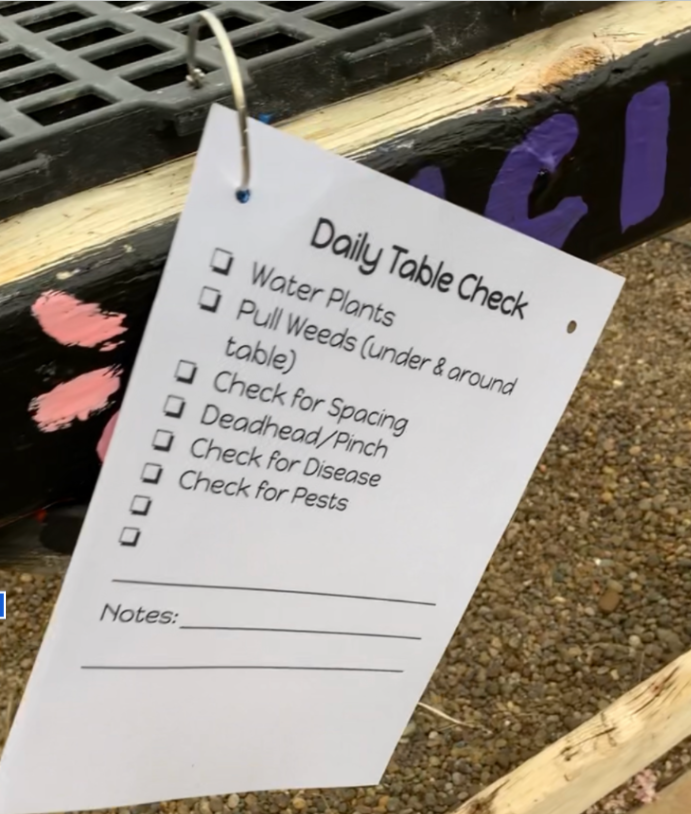
Utilize physical task boards and visual cue cards posted around the lab to clearly map out exit directions and daily expectations. By keeping routine instructions written down in high-traffic areas, you drastically cut down on the need to yell over machines. Here is an example from Cassidy’s greenhouse so her horticulture students know exactly what to do every time they are in the greenhouse.
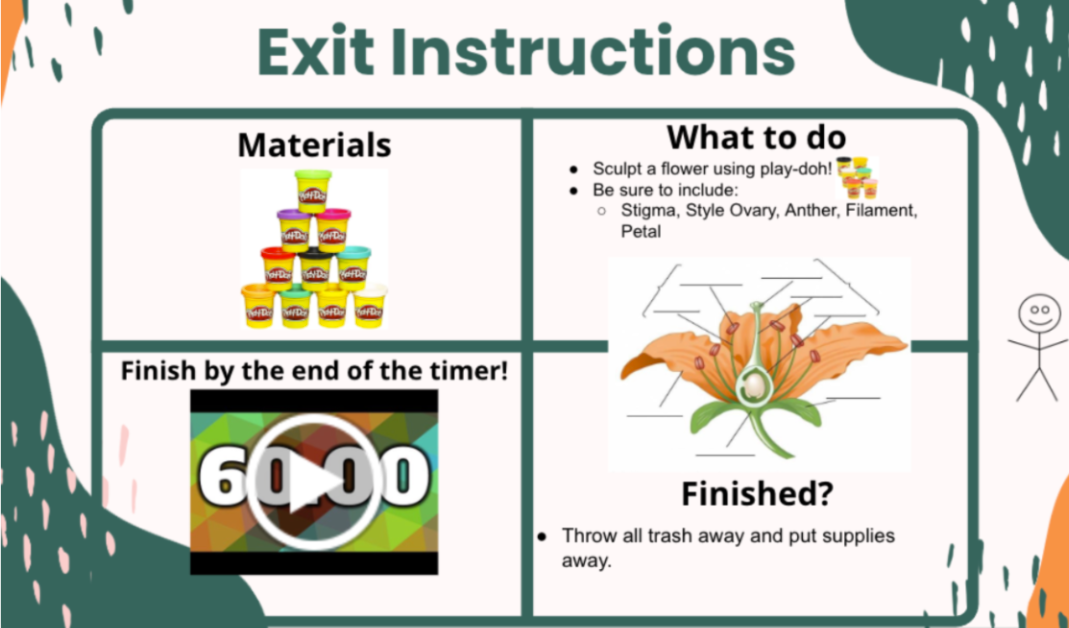
High-Tech Upgrade: Invest in a wearable voice amplifier headset (Sarah loves using this one daily) so you can speak at a normal volume while still reaching the back corners of the shop. You can also pair this with a central projector screen to display digital countdown timers, exit directions, and live visual noise meters (like Bouncy Balls). Below is a set of exit directions Laura used for her middle schoolers in the lab for modeling flower parts. If you have never made exit directions, check out this blog with more information.
Problem #2: Can Everyone See This?
Demonstrating intricate, hands-on skills becomes a major challenge when thirty students are all trying to crowd around a single workstation. The students in the back inevitably miss the subtle hand placements or safety nuances, leading to mistakes later on. If your students are constantly straining their necks or complaining that they can't see the demonstration, you need a better way to scale your view.
Low-Tech Fix: Use angled mirror tables suspended above your demonstration station (use your Perkins Funding or see if there is one available in your district before buying!) A free way to fix this is to break the class into rotating small-group demos while others work from printed photo guides. A past teaching partner did this in her Vet Science class. One station would be her demonstrating the new skill like suturing, and the other groups were cleaning the lab, working on notes or completing a project. This keeps the physical crowd small by you and ensures every student gets a clear, line-of-sight view of the technique.
High-Tech Upgrade: When you have time, record your demonstrations from a first-person perspective and post the videos directly to your LMS for easy student access. You can also print out QR code posters and tape them directly to the lab equipment, allowing students to instantly scan and watch a close-up tutorial right when they need it.
Problem #3: A Million Questions
When a lab gets moving, a teacher can quickly become the bottleneck as a line of students forms just to ask a quick question. I absolutely know you want to foster independence, but instead, you end up repeating the same troubleshooting steps twenty times in a single period. I know I can feel like a broken record on lab days if I am not careful. Finding a way to streamline these inquiries allows you to focus on critical safety interventions rather than basic logistics.
Low-Tech Fix: Implement an "Ask Three Before Me" rule. It is exactly what it sounds like, have students ask three classmates before they ask you! I recently saw the idea to designate a knowledgeable student to act as the official "Ask Siri" helper for the day on Instagram. I love the idea of elevating a student to a classroom leadership role to help lessen your load. You can also use a deli-style queue system where students grab a physical number and keep working at their desks until their number is called. This doesn’t have to be an actual deli system. In my class, I printed numbers on card stock, laminated them, punched holes and added a binder ring to them. They live on my whiteboard and students can grab when they need it. I use my voice amplifier and rally my inner robotic voice and say “now serving number 5” to find my next student.
High-Tech Upgrade: Set up a dedicated class discussion board or group chat on your LMS where students can crowd-source answers from one another in real time. You could also use a digital queue app like handraiseapp.com so students can virtually line up for help without leaving their workstations.
Want to bring these strategies to your school?
This is just a tiny sneak peek of what we cover in our signature professional development sessions!
If you want to help your CTE teachers tame the chaos and streamline their lab management, we would love to partner with you. Contact us today to see how we can help facilitate a custom workshop or presentation for your teacher group!
Stop Putting Yourself Last: How to Curate Your Best Teacher Summer Yet
How to Avoid Teacher Summer Burnout With Intentional Planning
Your expo markers are barely making streaks on the board but you can almost count the school days left on your hands (and maybe toes).
You are almost to the finish line.
Time to Curate Your Summer
If you are new around the G&G community you might now know our soapbox about focusing on you first and teaching second.
A lot of times we are thrust into the notion that we are teachers first.
We call bull.
We truly believe the best teachers focus on themselves first and then their career second. This can sound a little “woo-woo” and maybe you need some specific examples. Well I aim to please.
You choose your school based on the pay so you can support yourself/family
You leave at contract hours even when the to-do list is lengthy
You take sick days/personal days for anything you dang well please
You choose what FFA events you want to do not based on what your alumni/past advisor did
You plan your summer first and then fill in extended day/year requirements after
To help you curate the summer YOU want and need, we suggest working your way through 4 steps: me, you, us, school. Particularly in that order. Why?
Because I know you. I am similar to you. I (tend to) put everyone else’s responsibilities and needs above mine. Including my kids, husband, family, friends and students.
But, YOU need the break just as much as the kids. So we make sure we treat ourselves first, not last. Remember what they say in the airplane “put your mask on first before assisting others.” That is your summer mentality.
“Curate something for me, and then I will curate something for you”
4 Steps To Curating Your Best Teacher Summer Yet
ME
When I think about my summer I want to ensure I have an activity in each of my personal 3 circle model’s. iF you have no idea what I am talking about check out our blog You Are More Than Just a Teacher: How to Use the Three Circle Model Outside of the Classroom.
My personal 3 circle model includes adventures, growth and relationships. So, before I start worrying about who is going to what camp, what work events I need to go to, or if I really want to make it to that family vacation, I carve out time to ensure I pour into myself.
When I have activities in my three circle model, I show up better as a wife, mother, friend and teacher. And I am willing to bet when you do activities that align with your core values you do too.
Here is what I am planning this summer:
Adventure: (Half) Cross-country road-trip with lots of stops with family and friends!
Relationships: Going to see an off-Broadway play with a friend, hosting a crafty night with friends, having day dates with my kids and learning to bake sourdough with my sister
Growth: I am participating in a Summer Half-Marathon program with a local running community. My race will be in September!
These are BIG audacious things that I had penciled into my 2026 Yearly BINGO board but I also know that little sprinkles of joy throughout the weeks will help me enjoy summer as well. So, I plan to sprinkle little joyful (free/low cost) things throughout the summer like getting my favorite McDonald’s crispy coke zero, going thrifting, and reading outside.
What are some of the BIG and little things you can plan for yourself this summer?
SCHOOL
This is the category that will be different based on your contract. Some of you might work 45 days in the summer and some will have no contracted days.
Regardless, you will want to or need to do some school work in the summer. Maybe it is just cleaning the classroom, doing a few CDE practices, or a full fledged summer calendar that’s booked and busy.
The thing I want to stress is to only do what is necessary and will fill your cup.
This summer I have no contracted time. But, I do have the ability to take some time for some paid professional development after Germinate.
Once I reviewed my schedule and my family schedule I was able to book some classes where I get to learn something I WANT for the new year.
Summer school time doesn’t have to just be about checking boxes, it can be about leaning into learning new tools to help the next school year. If you aren’t sure what you need, check out our Germinate Tracks Quiz to help you figure out what sessions to prioritize at Germinate.
When you commit to something this summer, actually commit to it.
Put your required things on the calendar and carve out time for the things you want to do.
Treat it as a meeting/event and actually put it in your Google Calendar or paper calendar.
That means if you want to get coffee with a friend, block out those two hours. Or if your classroom needs your undivided attention, block another two hour block.
This will remind you that it is IMPORTANT to you!
YOU
This “you” category could include spouses, children, family members, roommates, friends etc. This is when you need to plan something FOR them, not WITH them. That is the next category.
For me it is childcare. Once I know my work and personal schedule, then I can figure out where I need support for family things like childcare or where I want to do bonding events like vacations.
Personally, we are in the season of camps not daycare and my kiddos basically like all the opposite things. I feel like a Jedi master trying to curate their summer schedule. But, good news is I have already scheduled my summer so I can fit their plans around mine.
I live by my family shared calendar and make sure that everything is accurately depicted so everyone knows exactly where we need to be and when.
And since I already know what I want to do for myself and what I need to do for my contract, I can easily see where I need to find support for the other people in my life.
If you are out of the daycare phase and have school aged kids I would HIGHLY advise you look at your local city/town/county recreation summer camps. My kids have gone to camps like skateboarding and flag football to chess camp and cooking camp. And usually for a MUCH cheaper rate than privatized camps.
I also am a huge supporter of high school camps. As an ag teacher, we ran Vet Camps and that paid our FFA chapter’s bills throughout the year. I loved those weeks in the summer and it feels good to give back to the high schools in my area now!
SPACE
Once you complete the me, school, and you categories you might realize that “gosh, this summer is FULL.” And that isn’t necessarily a bad thing especially if you are leaning into things that light your fire.
But, I also am a firm believer in a good dormancy day. Some people call it “rotting” but that assumes that the end result of a peaceful, no plan day is a bad result.
I vehemently disagree. When you take a step back and provide space in your calendar you are giving yourself time to recover and recharge for the next activities.
Just like trees have a dormancy period. They know they need to lay low and save energy in the winter so they can bloom in the spring.
So, now that all your required activities are on the calendar make sure to pencil in some dormancy days to conserve energy and prevent summer burnout!
Being able to have some summer time off with my family is something that I truly missed when I was out of the classroom. Even my husband is sad he is missing out on the simple low energy activities we have planning for our days off.
I hope with these suggestions in mind that you curate a summer that fills you up and serves you and yours well!
While we’re on the topic of teacher burnout, let it be known that here at G&G, it’s our goal to help you avoid that allll year long, not just in the summer time.
Here’s some more good reads and resources around this topic:
Feeling Overwhelmed as an Ag Teacher? A 4-Step Strategy for Asking for Help
Feeling Overwhelmed as an Ag Teacher? A 4-Step Strategy for Asking for Help
Something has seriously changed in my teacher brain once passing the decade mark in the classroom.
My to-do List will never be done. And that’s ok!
To be honest, I am not one who needs to check boxes to feel accomplished. I would much rather vision cast and brainstorm new ideas, however I fully understandI that many of my teacher friends (and even my husband) need to get tasks done to finally relax.
Regardless if you are a Type A check box teacher or a Type B go-with-the-flow, you may have felt the pressure of those tasks needing to get done. And maybe you have even worked yourself to the bone trying to make all the things happen on your own. Why? Because you might think…
The only way to get it done is to do it myself
I am the only one who can do this right
I don’t have time to train someone, so I have to do it
I have BEEN THERE and I’ll be honest it took me a while to realize I didn’t have to feel this way. I didn’t have to feel alone in my classroom, as an advisor, and most specifically with all the tasks on my to-do list.
If you actually did all the work on an Ag Teacher’s plate by yourself I think it would be a 24 hour/7 days a week/365 days a year job with more work to do.
But it doesn’t have to be this way if you implement one thing into your career:
Asking for help.
But, you might be saying…
What do I even ask for?
What can I even ask for help?
What if people say no?
Those are very valid questions that we have crowdsourced the answers to. Because we get it, asking for help is an acquired taste that a lot of us overachievers hate more than the taste of Vegemite or Robitussin.
I have suffered alone many a times.
We all found ourselves at this place…we hit our breaking point of searching through Facebook Groups, TPT, Pinterest Boards and TikTok.
Our turning point was when we decided to SHOW UP. When we decide enough is enough and it’s time to show up for ourselves by seeking the help we need.
And showing up for yourself and asking for the help you need is vital because SUPPORT ISN’T SENT, IT IS SOUGHT.
Those good natured teachers, community members and admin who have said to you “I'm happy to help” “just shoot me a text if you need me.” or “I’m always here to help” don’t know you need help unless you tell them. It isn’t on them to check in on you constantly asking if you need support. It is YOUR job to stand up and say “it’s time, I need help.”
In this blog post, we’re sharing four steps that you can use as you start utilizing your community to get the help you need.
4 Steps to Stop Feeling Overwhelmed as an Ag Teacher
Step 1: What do you REALLY need help with?
First things first, what is the monkey on your back right now. What is that thing that you cannot stop thinking about even though you aren’t at school? What is that thing that no matter how much time and effort you put into problem solving you cannot find a solution? You need to name that exact thing before you can ask for help.
One of the biggest problems with asking for help is the CLARITY of your problem. When we are clear on what we need help with we can be strategic about who we are asking for help. Which leads us to step 2.
Step 2: WHO Can Help?
Now that you know your problem, start brainstorming who could help you with that problem. Who do you already know that could help you find a solution?
Here are some ideas to get you going, but remember that during this step you are starting with a name, not a solution.:
A teacher
A former mentor
An administrator
An ag teacher friend
An industry contact
“That person I always text”
Step 3: Can THEY help?
I can already tell that some of you might be stumped on step 2. You might be thinking “if I knew who to ask I would have already done it.” Maybe it is truly you don’t know who could help. Then we need to start thinking about GROUPS of people that might be able to get you connected with the right person.
Remember for this step you don’t need the exact person to help you solve, just a door to get you to that person. Here are some ideas that might help:
State Ag Teachers Association
FFA Staff
Extension
Direct support team in your school
The G&G Team/Community
Step 4: WHAT do I need to ask?
OK, hopefully you have a person or a group that you feel confident asking for help from. Now, we need to get to asking the question. We as ag teachers tend to have our own vocabulary and ways of saying things that might not make sense to others, so this step is imperative so we clearly share our problem. We know that vague problems get vague help BUT specific problems get solved.
Here are a few sentence frames that might help you get those specific details out to your identified solution person/group:
“What’s overwhelming me is ___________. I think this because_______________”
“I am finding______________ very difficult because______________”
“I am stuck on _________________ because____________________.”
Once you have completed Steps 1-4 you are READY to reach out to the person/people you want to get assistance from. We absolutely know as teachers ourselves that asking for help can seem daunting. But, what we also know is that you might not be alone in this. Someone out there knows the solution and just doesn’t know you need it.
Teachers don’t always lack support, they lack clarity about who to ask and what to ask for. This 4 step strategy is your ticket to getting closer to solving your complex problems. As you step into asking for help remember that asking for help isn’t about being less capable, it's about being more precise.
And if you are looking for specific help in the Agriculture Education space, your first stop to getting connected to experts in our very specialized area is the newly revamped and launched G&G Specialist Roster. You can even add your name to the roster in areas you are an expert to be a help when someone else is in need.